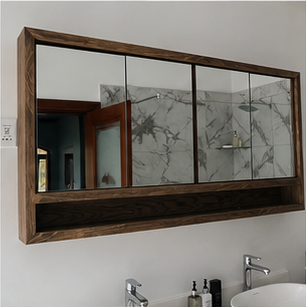
When people describe a mirror as looking “green”, they are usually noticing the natural colour of standard float glass. The effect is most visible along a thick edge, at a cut-out or where a large mirror sits against a pale, carefully finished bathroom.
Where the colour comes from
Ordinary glass contains iron that gives the glass a subtle green tone. The mirror coating reflects the image, but it does not make the glass itself completely colourless. On a small framed mirror this may be barely noticeable. On a large unframed panel, the edge and reflected wall can make the difference more apparent.
What low-iron glass changes
Low-iron glass is manufactured to reduce the green cast and produce a cleaner, more neutral view. This can be valuable where the mirror is part of a restrained stone, white, brass or soft-grey palette and the design depends on colour accuracy.
It is not automatically the right choice for every bathroom. The final result also depends on the mirror coating, thickness, lighting, wall colour and the quality of the installation.
Look at a real sample
Do not judge a premium mirror from a small online photograph. Compare samples under the type of lighting planned for the bathroom, ideally beside the actual stone, tile or vanity finish. A colour difference that seems minor in a showroom can become more visible across a wide mirror wall.
The edge still needs care
Low-iron glass does not make the mirror immune to moisture, impact or installation damage. The perimeter must still be protected, the adhesive must be compatible and water should not remain trapped behind the glass.
For a luxury bathroom, optical neutrality is one part of the specification. It should be considered alongside safety, edge treatment, lighting and long-term serviceability.
Read about what premium mirror glass specifications mean, or see how lighting colour temperature changes a bathroom.