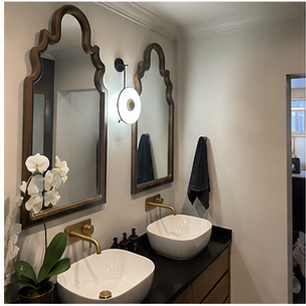
A shaped mirror can turn a bathroom wall into a deliberate design feature. A round, pill-shaped, arched or organic outline may soften a room full of hard surfaces, but the shape is only the beginning. The frame, edge, mounting method and surrounding clearances decide whether it feels refined or improvised.
The silhouette must belong to the room
The mirror should relate to the basin, vanity, wall lights and other vertical lines. A pill shape may echo a curved basin or soften a narrow powder room. An arch may suit a more architectural interior. An isolated shape with no relationship to the rest of the room can look decorative rather than integrated.
Frames change the final size
The quoted glass size is not always the visible mirror size. A metal, timber or stone frame adds thickness and changes the gap to the wall, tap and lighting. Confirm whether dimensions refer to the glass, the outer frame or the finished installed product.
Fixing is part of the design
A heavy framed mirror may need a different fixing method from a frameless panel. The wall substrate, tile, backing, hanging rail and service access need to be considered before the final surface is closed. Adhesive alone is not a universal solution for every custom mirror.
Leave room to clean it
Complex frames can create ledges where dust, moisture and cleaning residue collect. In a coastal Durban bathroom, the perimeter should be easy to wipe and should not trap water against the mirror backing or metal finish.
Draw it at full size
For a custom mirror, a full-size template or taped wall outline can be more useful than a small design sketch. It reveals whether the mirror is too dominant, whether the lights sit comfortably beside it and whether cupboard doors or taps will conflict.
The best custom mirror is not simply unusual. It is correctly proportioned, correctly fixed and easy to live with.
Read about one wide mirror versus two above a double vanity, or see how mirror height must coordinate with the basin and tap.