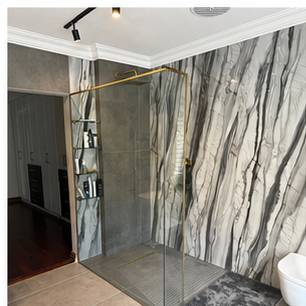
Lippage is the height difference between the edges of neighbouring tiles. It can be felt by hand, seen in a raking light or noticed where a towel, cleaning cloth or bare foot passes across the joint.
Why large tile can make it more obvious
Large tiles span farther and may have a slight manufactured bow. They also reveal uneven substrates over a greater distance. A polished or lappato finish can make the change more visible as light moves across the wall.
The issue is not solved by assuming that a rectified edge means a perfectly flat tile.
Preparation controls the starting point
Levelling clips can help neighbouring pieces stay aligned, but they cannot straighten a wall or floor. The substrate must be prepared to suit the tile and adhesive system before the fixing starts.
The layout should also consider offsets, corners, niches, door openings and the direction of light.
The pattern can affect the risk
Some large-format tiles should not be installed in a full 50% brick bond because of the relationship between the centre of one tile and the end of another. The correct offset or aligned layout depends on the actual product and guidance.
A good installation method respects the tile’s manufacturing characteristics instead of trying to force every product into one pattern.
Lippage is prevented, not polished away
Once the adhesive has cured, grinding or aggressive correction can damage the surface. The better approach is to control the substrate, bed, coverage, handling and layout before the tile is fixed.
See why levelling clips cannot level a substrate, or read why a 50% brick bond can fail.