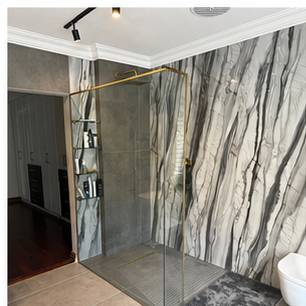
It is tempting to treat the largest available porcelain slab as the most luxurious option. In practice, format should be selected from the room and the installation plan.
Bigger can mean fewer joints
A larger slab may reduce horizontal or vertical breaks across a feature wall. That can help a marble-look pattern read more continuously and reduce the amount of grout visible in the finished room.
It can also create larger cuts, more demanding handling and a greater consequence when access or substrate preparation is not right.
The wall and route set the limits
The dimensions of the finished elevation are only one part of the decision. The slab must get through the property, around corners, into a lift or up stairs, then be positioned without damage. Apartment and estate work may also require delivery bookings or restrictions.
The best format is one that can be delivered and fixed safely while still producing the intended composition.
Pattern and cuts may favour a smaller piece
A smaller slab can sometimes place a vein, niche or basin more successfully than a larger piece with unavoidable cuts. The visual outcome depends on where the joints fall.
This is especially true where a wall contains a window, mirror, concealed mixer or shower niche.
Choose the format as a system
Review the tile range, thickness, access, handling, substrate, fabrication, adhesive, joints and future serviceability together. A 1200 x 2800 slab may be the better answer in one bathroom, while a larger format may suit another.
Luxury is not measured by maximum size. It is measured by how well the material belongs to the room.
Continue with porcelain slab site-access planning, or read why 6 mm porcelain needs specialist handling.