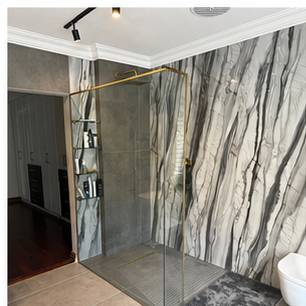
Rectified tiles are cut after firing so their edges are unusually straight and consistent. That precision is one reason they are popular in high-end bathrooms: the finished surface can have a quieter grid and finer-looking joints.
It does not mean the tiles should be installed without grout.
Rectification improves the tile, not the building
Even a carefully manufactured tile is being fixed to a wall or floor that has its own tolerances. Substrates move, rooms change temperature, adhesive beds vary and tiles can have small dimensional differences between batches. A grout joint gives the installation somewhere to accommodate those realities.
The tile itself may be precise. The room is not manufactured to the same tolerance.
A very narrow joint is not automatically a better joint
Joint width should be selected from the actual tile, substrate, layout and manufacturer guidance. A narrow joint can look refined, but it also leaves less room to absorb variation. If the edges are forced tightly together, the installation may show lippage or edge pressure rather than the calm, continuous finish the homeowner expected.
The correct joint is also easier to clean and inspect than a hairline gap that traps residue or cannot be filled consistently.
The joint is part of the design
Grout colour changes how a rectified tile reads. A close colour can soften the grid. A contrasting colour makes every line more visible. With a large-format marble-look porcelain, the joint position also affects whether the printed movement flows through the room or stops awkwardly at each tile edge.
That decision belongs in the layout stage, before fixing begins.
What should be checked before installation?
The tile range, batch, substrate flatness, joint recommendation and movement-joint requirements should all be reviewed together. A dry layout is useful for checking cuts, focal points and the relationship between the tile and fittings.
Rectified porcelain can produce a beautiful luxury finish, but its precision is not permission to ignore the installation system. The joint, adhesive, substrate and layout still have to work as one.
For a Durban renovation, Signature Bathrooms plans the visible tile finish together with the preparation beneath it. See the wider bathroom renovation process, or continue with our guide to large-format tile substrate preparation.