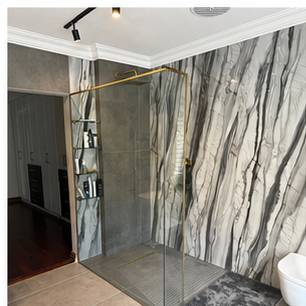
“Large-format tile” is used for products that are substantially larger than ordinary wall or floor tile, but there is no single size that explains every installation decision. A 600 × 1200 mm tile and a 1200 × 2800 mm slab create very different handling and preparation demands.
Size changes the process
As the tile grows, access, stiffness, weight, cutting, support, substrate flatness and adhesive coverage become more significant. The installer needs to plan the route from delivery to the final wall, not only the position of the finished piece.
The visual benefit is fewer interruptions
Large-format tile can reduce grout lines and allow a printed stone pattern to read across a broader surface. That benefit is strongest when the cuts, joints, niches and service penetrations are coordinated.
The largest tile is not always the best layout for a small or highly interrupted room.
The technical documents matter
The product’s thickness, backing, application, handling and installation guidance should be checked from the manufacturer. Retailer descriptions are useful for discovery and availability, but they may not contain all the detail needed for fixing.
Large-format is a system choice
The term describes a design opportunity as much as a product dimension. The substrate, adhesive, tools, access, fabrication, support, joints and waterproofing all need to suit the material.
A large tile can create a remarkable bathroom, but only when the room is prepared for the size chosen.
Read why 1200 × 2800 and 1600 × 3200 are different decisions, or see why large tile needs straighter walls.