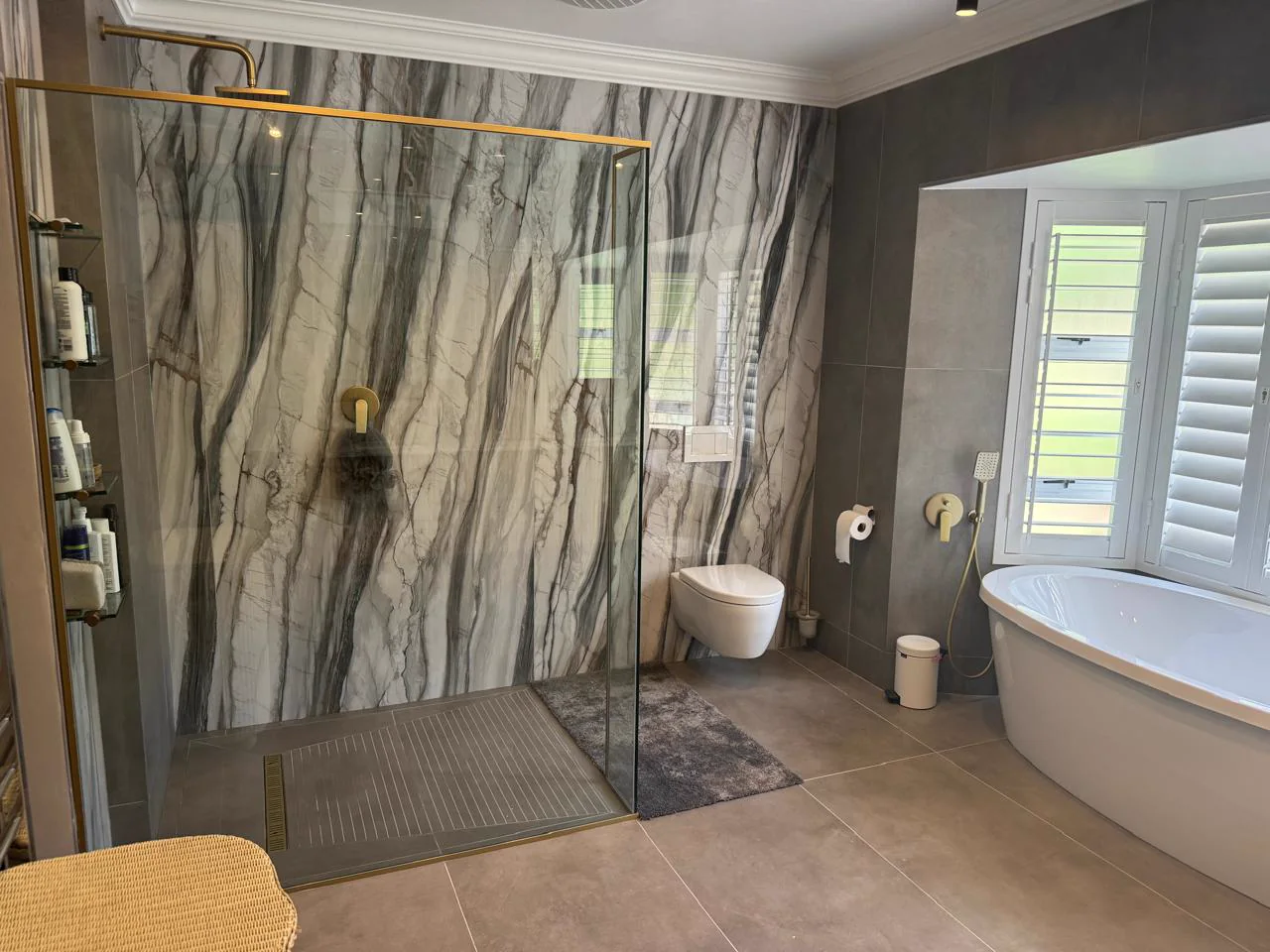
Travertine is defined by its natural openings and movement
Travertine can bring warmth and an understated spa character to a bathroom. Its natural voids, layering and variation are part of the material, not manufacturing defects to be hidden without a plan.
The way travertine is cut and finished changes the appearance and the maintenance expectation.
Filled and unfilled
Filled travertine has its natural voids filled before or during finishing, creating a more uniform surface. Unfilled travertine leaves more of the natural texture visible and may require a different cleaning and maintenance approach.
The choice is partly aesthetic, but it also affects how water, residue and cleaning behave across the surface.
Cross-cut and vein-cut
Cross-cut travertine can show a cloud-like or circular movement. Vein-cut material emphasises the geological layers in a more linear direction. Neither is automatically better; the choice should suit the room’s proportions and the desired visual rhythm.
The actual slabs or tile batch should be reviewed because website images do not show the full range of variation.
Install and maintain it as natural stone
Travertine still requires a suitable substrate, adhesive, waterproofing system, movement joints and sealing approach. Sealer does not replace the wet-area membrane, and harsh acids can damage calcium-based stone.
In a humid KZN bathroom, the finish should be chosen with realistic care in mind. Travertine can be luxurious without pretending to be maintenance-free.
See the Signature Bathrooms renovation process at our renovation process.
Continue planning your renovation
For a related question, continue with related bathroom renovation guidance.