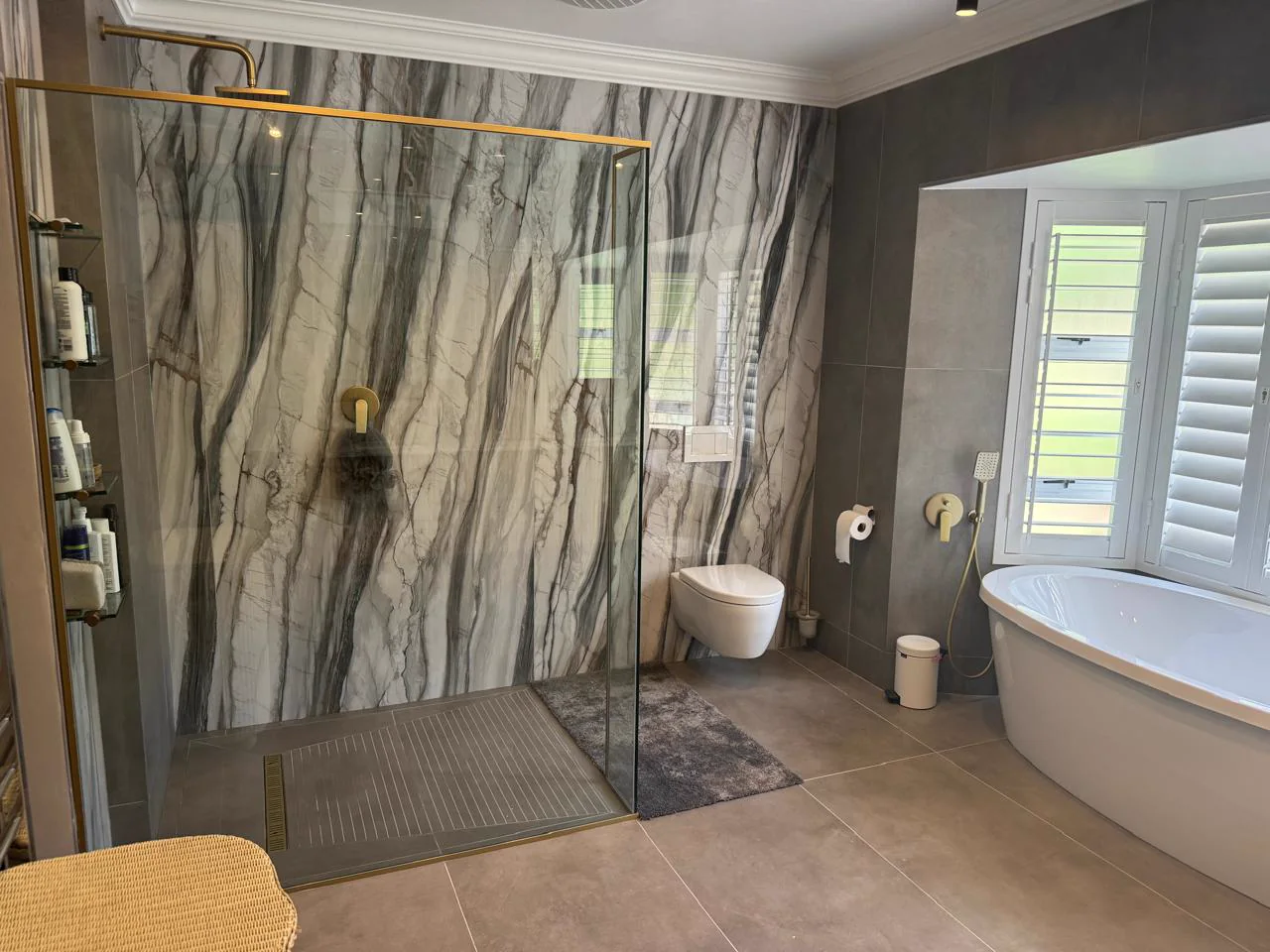
Natural stone should be chosen as a system
Marble, onyx, quartzite, travertine and other premium surfaces can transform a bathroom. The important decision is not simply which stone looks attractive in a showroom. The material has to suit the wet area, the substrate, the fabrication method, the lighting, the maintenance routine and the client’s expectations.
In Durban, Umhlanga, La Lucia, Ballito and the wider KZN region, a luxury bathroom also has to work in a humid coastal environment. Stone selection, waterproofing and ventilation are related decisions, but they are not interchangeable ones.
Start with the application
A stone that is suitable for a vanity top may not be the best choice for a shower floor. A dramatic onyx feature wall may be ideal outside the direct spray zone but inappropriate for a heavily used family-bathroom floor. A polished surface may look exceptional while being the wrong choice where slip resistance and hard-water maintenance are the priority.
The room’s use should come before the product name.
View the actual slab
Natural stone varies from slab to slab. Veining, fissures, resin repairs, mesh backing, translucency and usable dimensions can all affect the final design. A small sample or online photograph is not enough to plan a book-match, a vanity cut-out or a full-height shower wall.
The actual slabs should be inspected, mapped and reserved with the fabricator before the final cuts are approved. The strongest movement should be placed where it will be seen rather than lost behind a fitting.
Build the wet-area system behind the surface
The stone is not the waterproofing. The substrate, membrane, corners, pipe penetrations, niches, wastes, adhesive and movement joints must be specified for the exact application.
The adhesive also matters. Light marble, moisture-sensitive green stone and resin- or mesh-backed slabs may require different systems. A premium product name does not remove the need to read the manufacturer’s technical guidance.
Fabrication is part of the design
Large panels, mitred edges, book-matched walls, stone niches and custom vanity tops need accurate measurements and a cut plan. Mixer positions, basin cut-outs, glass lines, floor levels and access requirements should be resolved before the stone is fabricated.
For backlit onyx, the stone, support, light distribution, diffusion, wiring and service access must be tested together. It is a lighting and stone system, not a slab with a bright bulb behind it.
Set expectations at handover
Natural stone can be exceptional, but it is not maintenance-free. Marble and onyx can be sensitive to acids, abrasive cleaners, mineral deposits and careless use. Sealer can help with staining, but it is not a waterproof membrane and cannot make a calcium-based stone acid-proof.
The client should receive the known stone details, finish, care instructions and product information with the handover records.
Explore the specialist guides
- Marble in a shower: what happens behind the stone
- Why white marble needs the right adhesive
- Planning a book-matched marble bathroom
- How a backlit onyx wall is built
- Caring for marble in hard-water conditions
Signature Bathrooms approaches luxury surfaces as part of the construction, not as decoration added at the end.