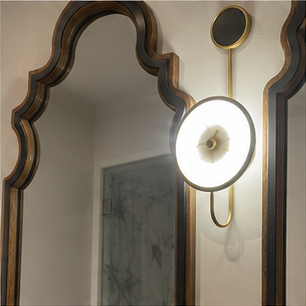
The control on an illuminated bathroom mirror seems like a small choice, but it affects everyday use. Touch controls and hand-wave or infrared sensors can both be suitable. The better option depends on the mirror position, the room’s lighting, cleaning habits and how much control the user needs over brightness and colour.
Touch controls
A touch switch gives a clear physical interaction. It can be easier to understand and less likely to react when someone walks past the mirror. The trade-off is that the user touches the glass with wet or soapy hands, and the switch position needs to remain visible without disturbing the mirror’s design.
Infrared or hand-wave controls
A sensor can be useful when the mirror is wet, when hygiene is a priority or when the control needs to remain visually discreet. It must, however, be positioned and calibrated so that normal movement in front of the basin does not repeatedly trigger the light.
Dark finishes, strong daylight, reflective surfaces and the user’s distance from the sensor can affect how an infrared control behaves. The actual manufacturer’s instructions matter more than a generic promise that every sensor will behave the same way.
Brightness and memory
Ask whether the selected product remembers the last brightness or colour-temperature setting after power is interrupted. A mirror that returns to full brightness every time can be unpleasant in a night-time bathroom. Confirm whether the control offers dimming, colour adjustment and a reliable auto-off function.
Keep the failure mode in mind
If the sensor or touch control fails, can the mirror still be switched safely? Is the component replaceable? Where is the driver? These questions matter more for a premium fitting than the novelty of waving at the glass.
Choose the control with the room
For a guest WC, a simple, obvious touch control may be the most dependable choice. For a main bathroom with frequent wet hands, a well-specified sensor can be worthwhile. In either case, confirm the control behaviour before the mirror is installed and record it in the handover information.
Read about service access for smart-mirror electronics, or compare front-lit and backlit mirror lighting.