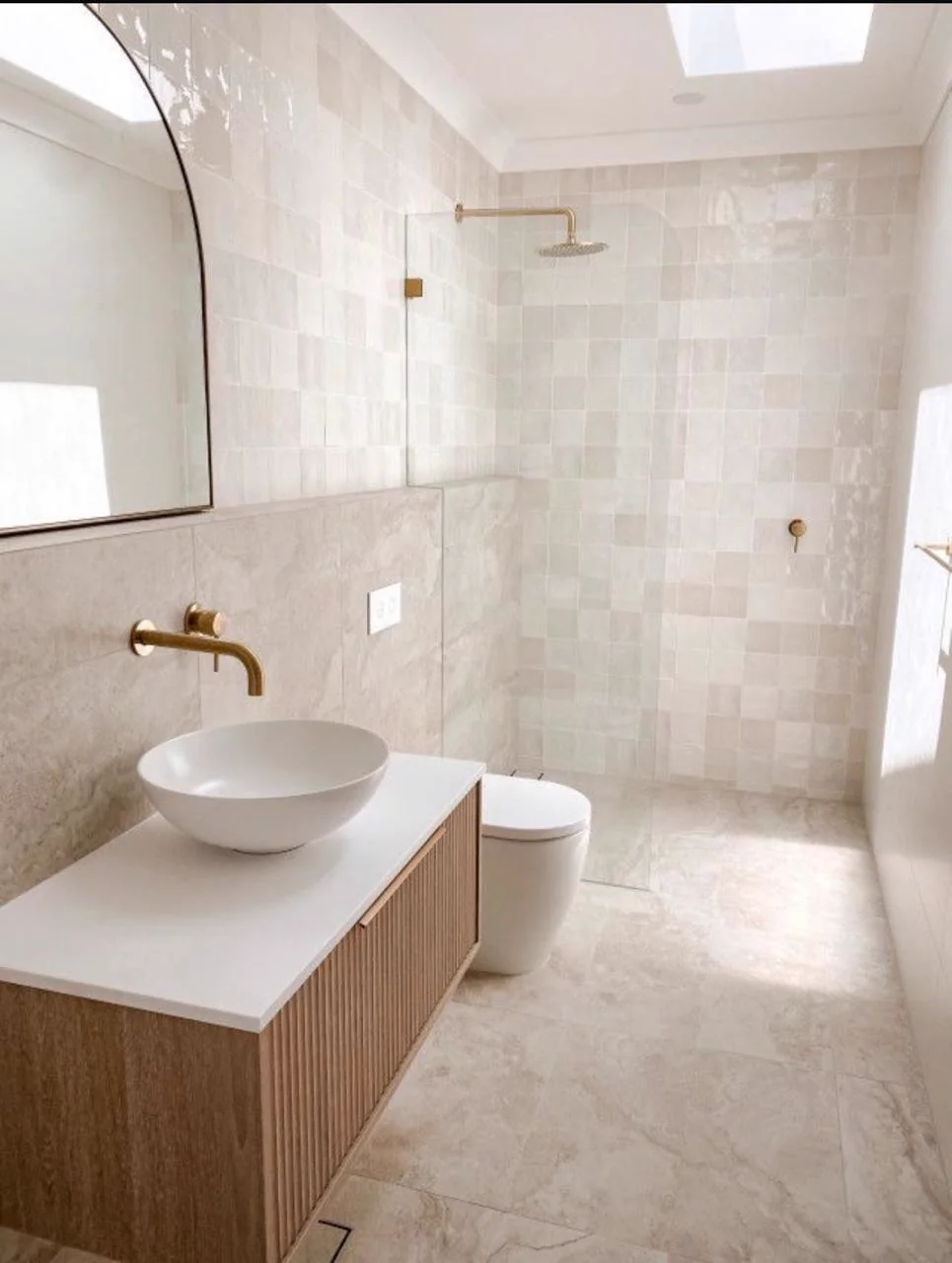
A tile sample is useful, but it is not the bathroom. A small board on a showroom shelf cannot fully show how a large-format porcelain surface will behave across a wall, beside a mirror or under the lighting in a Durban home.
Scale changes the pattern
A vein that looks delicate on a small sample may become the dominant feature across a 1200 mm or 1600 mm tile. A quiet surface may also feel repetitive once several pieces are installed beside one another.
This is why the number of faces, shade variation and intended orientation should be discussed before ordering a full room.
Lighting changes the finish
Natural light, downlights, wall washing and mirror lighting reveal different things. A polished surface may throw strong reflections. A matt surface may absorb the light and make a room feel softer. A lappato finish can change character as the light moves across it.
The finish should be viewed under lighting that resembles the completed room where possible.
Grout and layout are part of the sample
The same tile can read differently with a matching grout, a darker grout or a deliberately contrasting joint. The planned cuts around a niche, window, basin or shower mixer also affect the finished composition.
A dry layout or scaled elevation is often more informative than choosing from one loose piece.
A practical selection check
Before committing to a premium tile, review the actual product, finish, size, shade range, faces, technical application and maintenance information. Consider a larger mock-up when the surface is a major feature or when the material is expensive to replace.
Luxury is not simply finding a beautiful tile. It is checking that the tile will still look right after it has been scaled, cut, lit, grouted and lived with.
Continue with why tile-face variation matters, or see our bathroom renovation planning guide.