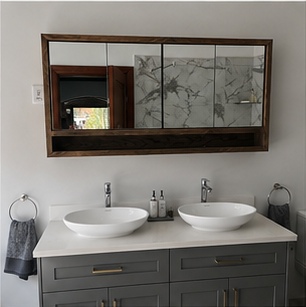
A double vanity gives you two obvious mirror options: one broad mirror spanning the whole composition, or two separate mirrors aligned with the basins. Neither is automatically the more luxurious choice. The right answer depends on the wall width, the basin and tap layout, the lighting plan and how much visual calm the room needs.
When one wide mirror works well
A single mirror can make a wall feel broader and less divided. It is often effective where the vanity is long, the basins are close together and the design is deliberately quiet. A continuous reflection can also help a smaller bathroom feel more open.
The important detail is not simply ordering a mirror to the vanity width. The finished wall, side clearances, lighting, wall-mounted taps and any cabinetry above the basin all need to be drawn together before the glass is cut.
When two mirrors are the better answer
Two mirrors give each basin its own visual zone. They can suit a more architectural layout, especially where the basins are widely separated or where a central wall light, timber panel or structural feature needs to remain visible.
They can also be easier to remove or replace individually. That matters when a mirror includes electronics, demisting or integrated lighting, because one failed unit does not necessarily mean replacing the entire wall installation.
The lighting decision comes first
With two mirrors, each person can have a more predictable light source. With one wide mirror, lighting must be positioned so that the centre of the composition does not become bright while the faces at either side remain poorly lit. Side lighting can often produce a better result than relying on a narrow LED strip hidden behind the glass.
What to decide before manufacture
Confirm the basin centres, tap positions, finished wall dimensions, mirror thickness, edge treatment, electrical feed and the intended mounting method. If the mirror is made before the final wall and stone dimensions are known, a small site variation can make the finished gaps look accidental.
For a high-end bathroom, the mirror should be resolved as part of the vanity elevation, not selected as a loose accessory at the end.
A practical design test
Mask the proposed mirror shapes on the wall or elevation drawing. Look at the gaps to the side walls, the gap between the mirrors and the relationship to the basin centres. The most expensive mirror can still look wrong if its proportions do not belong to the vanity below it.
Read how mirror cabinets add practical luxury, or see the double-vanity planning guide.