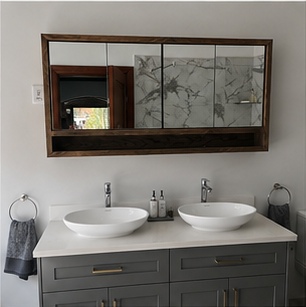
A mirror cabinet can do more than reflect a face. It can provide concealed storage, integrated lighting, demisting and sometimes charging or other electrical functions. Its success depends on what happens inside the wall and behind the doors, so it should be treated as a built-in product rather than a mirror hung at the end.
The cavity is part of the design
Recessed cabinets need a suitable wall depth and a clear route for services. A masonry wall, dry-lined wall and tiled build-up do not offer the same options. Existing plumbing, electrical cables and structural elements may limit how far the cabinet can be recessed.
If the cabinet is surface-mounted, the projection affects the basin, tap reach, door swing and circulation. That projection should be shown on the bathroom elevation before the vanity is ordered.
Power must be planned, not improvised
An LED mirror cabinet may need a concealed supply, driver location or switched control. The electrician should know the selected product and the final position before the wall is closed. Bathroom electrical work must be carried out and certified by the appropriately qualified professional; a later extension lead is not a luxury installation detail.
Service access matters
Drivers, switches, sensors and demister components can eventually need attention. Do not bury a removable component behind permanent tile, stone or cabinetry without a service strategy. The manufacturer’s installation instructions should determine what can be accessed through the cabinet, flush plate or removable panel.
Check doors against the room
A cabinet door can conflict with a wall, light fitting or a person standing at the basin. Two narrower cabinets may provide better access than one very wide door, while a mirrored sliding door may solve a tight circulation zone. This is a design and usability decision as much as a product-size one.
Confirm the final product early
Before ordering, check the cabinet dimensions, hinge or sliding-door arrangement, IP rating where applicable, electrical requirements, demister controls, ventilation requirements and warranty conditions. Keep the installation manual with the project handover records.
Read why smart-mirror electronics need service access, or see the bathroom electrical planning guide.