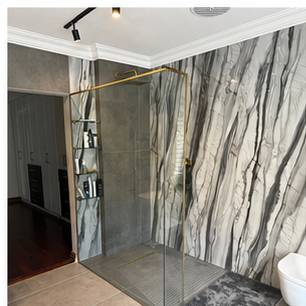
Endless-veining porcelain is designed to make a printed stone pattern continue more naturally from one piece to the next. It can be an impressive solution for a feature wall, but the word “endless” does not remove the need for layout planning.
The print still meets a real room
Walls contain corners, windows, mixers, niches, mirrors and openings. The pattern can be interrupted by a cut even when the original tile image is highly continuous. The centre line and direction of the feature should be agreed before fabrication.
Digital does not mean random
The range still has a defined set of images, shade behaviour and product formats. Pieces need to be opened, viewed and arranged so that a strong vein does not land in an awkward place or repeat too close to itself.
The technology helps. It does not replace the installer’s eye.
Lighting changes the result
Wall-washing, downlights and natural light can emphasise different parts of the printed movement. A sample should be considered beside the actual lighting and adjoining materials, especially when the finish is lappato or polished.
The best result is still a designed result
Endless veining can give a bathroom the calm of a slab with the practical consistency of porcelain. The final quality depends on selecting the right format, planning the cuts, preparing the substrate and controlling the installation.
Read why the number of tile faces matters, or see why a tile sample is not the full bathroom.