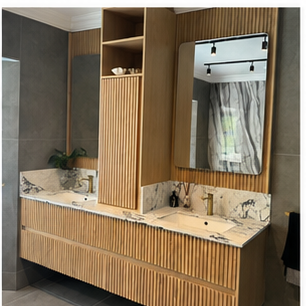
Minimal rooms have nowhere to hide
A long vanity, a wide mirror and large-format tile create strong horizontal and vertical lines. When the drawer gaps are even, the room feels calm. When one front sits out of alignment, the error can be noticed immediately.
The same applies to tile joints, basin centres, mixer positions and mirror edges. A luxury finish is often the result of many small relationships being controlled at once.
Alignment begins before the cabinet arrives
The wall may not be perfectly straight. The finished floor level, tile thickness, countertop edge, basin and mirror all affect the final elevation. Scribe panels, fillers and shadow gaps can absorb controlled variation; a large bead of silicone should not be the default solution for poor measurement.
Hardware alignment also depends on the drawer system, cabinet construction and installation adjustment. Push-to-open fronts require especially careful setting out because there is no handle to distract the eye.
Measure from shared finished datums
The cabinetmaker, tiler, plumber and mirror installer should work from the same finished-floor level, top height, basin centre lines and wall references. This reduces the chance that every trade is accurate to a different drawing.
The final result should look simple because the coordination was not.
Continue with custom vanity planning, or see why old walls need scribe panels.