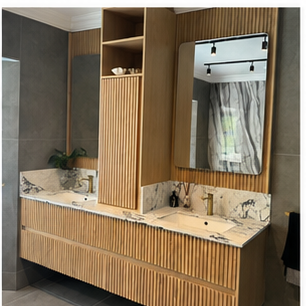
Timber is a material choice, not a maintenance-free promise
Real timber, veneer and timber-look board create different visual and technical results. Real wood has natural movement. Veneer provides genuine grain over a stable substrate. A melamine-faced board offers a predictable factory surface.
The right choice depends on the design, the construction, the finish and the room’s exposure. None should be treated as immune to water.
Wood moves
Timber absorbs and releases moisture as the room’s humidity changes. The construction and finish need to accommodate that movement instead of pretending the material is dimensionally inert.
This is particularly important for wide doors, long panels, fluted fronts and feature wall cladding. Joints, edges, backing and ventilation behind the material all contribute to how the finished work behaves.
Ventilation helps the finish last
An extractor does more than clear a fogged mirror. It helps the room dry after bathing and reduces the moisture load placed on joinery, paint, sealant and metal finishes.
Splashes should still be wiped promptly, and cleaning products should follow the finish manufacturer’s guidance. Ventilation cannot correct a leaking trap or unsealed edge, but poor ventilation can shorten the life of a sound cabinet.
Choose the finish for the room
A furniture finish intended for a dry bedroom is not automatically appropriate beside a frequently used basin. The complete finish system, application method, cure time and maintenance instructions should be confirmed for the exact timber or veneer.
Luxury is not simply the presence of timber. It is the confidence that the timber has been selected, finished, installed and maintained as a bathroom material.
Read why moisture-resistant board is not waterproof, or see the coastal bathroom planning guidance.