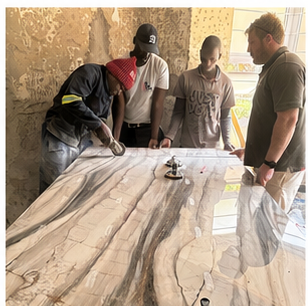
A premium tile can still fail if it is fixed with an unsuitable adhesive. The adhesive should be chosen from the actual tile, substrate, location and manufacturer’s installation system rather than from habit or price alone.
Different tiles create different demands
Porcelain, ceramic, stone, mosaics, large slabs and resin-backed materials can each affect the bonding decision. A low-absorption tile may need a different system from a more absorbent product, while a large or thin piece places additional demands on coverage and handling.
The exact class and product should be confirmed from current technical documentation.
The substrate is part of the system
An adhesive cannot correct damp, movement, contamination or a wall that is outside the required flatness. Primer, preparation, waterproofing and curing conditions may also be relevant depending on the substrate and system.
Mixing products from unrelated systems can affect compatibility and warranty conditions.
Working conditions still matter
Open time, pot life, bed thickness, temperature and substrate absorption influence how the adhesive behaves. A product selected on paper still has to be mixed, spread and used within its stated parameters.
This is why manufacturer data sheets and installation guides are more useful than a generic rule that every bathroom can use the same adhesive.
The invisible specification protects the visible finish
Tile, adhesive, substrate, grout, sealant and waterproofing should be treated as one coordinated installation. The finished room may look simple, but the system behind it is what gives the surface stability.
Read why adhesive coverage matters on large tile, or see why porcelain and ceramic are not interchangeable labels.