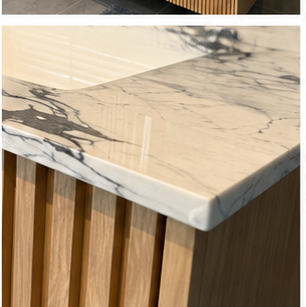
Porcelain can be used to create a sharp, architectural vanity surface with a strong relationship to the wall tiles. The finished result depends less on the material name than on the cut-out and support decisions made before fabrication.
The basin fixes more than its own opening
Countertop, undermount and inset basins each create different edge and support requirements. The basin model, rim, tap-hole arrangement and waste position should be confirmed before the slab is cut.
A wall-mounted tap also changes the relationship between the finished wall, spout projection and basin. These are not independent selections.
Thin edges need support and control
Large porcelain pieces can be strong in the right system, but a narrow unsupported edge or a poorly placed cut-out can create vulnerability. The substrate, cabinet, brackets, joints and handling method all need to suit the actual product and thickness.
The fabricator should work from an approved template rather than a rough measurement taken before the walls and cabinetry are final.
Cut-outs should be designed, not hidden
The basin, tap, wall returns and tile joints should read as a single composition. A small shift in a cut-out can make a vanity look unbalanced or leave an awkward strip at the wall. With patterned porcelain, the direction of the print should also be considered.
This is where detailed drawings and a site measure protect the expensive material.
Maintenance access still matters
The vanity must remain serviceable. Waste connections, traps, isolation points and any concealed equipment should be reachable without damaging the porcelain or cabinet. A beautiful top that cannot be maintained is an incomplete design.
Porcelain can be an excellent vanity material, but the success is in the coordination between slab, basin, tap, cabinet and installer.
Read stone vanity fabrication and basin support, or continue with wall-mounted basin tap coordination.