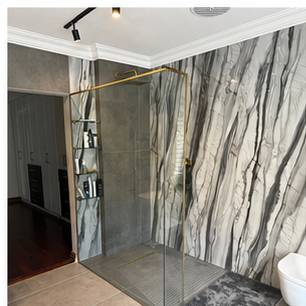
A frameless shower can look effortless against a large porcelain wall, but the hardware still needs to be fixed somewhere. Hinges, clamps and stabiliser bars may require carefully positioned penetrations through a brittle finished surface.
The glass and tile layouts must agree
The door edge, fixed panel, hinge centres and clamp positions should be drawn over the tile elevation. This helps decide whether a fixing lands in the centre of a tile, near an edge, across a grout joint or in a position that conflicts with the internal substrate.
Porcelain rewards accurate set-out
Large-format porcelain is hard and can be unforgiving around holes and corners. A late change to the glass hardware can require a new penetration, a visible patch or replacement of a large tile. The tile installer should know the intended hardware before cutting.
The fixing still needs a sound wall
A neat hole through porcelain is not enough. Behind it must be a suitable substrate, with the waterproofing interface and fixing method properly considered. The glass installer, tiler and waterproofing team should not each solve their part independently.
Protect the finished surface
Drilling should be carried out with appropriate equipment and technique, with the finished surface protected from impact and vibration. The exact method depends on the selected tile and hardware and should be handled by experienced trades.
This coordination is one reason a premium shower enclosure should be designed before final tiling, even if the glass itself is measured later.
Read about why shower-glass measurement happens after finishes, or see why large-format tile needs a straighter substrate.