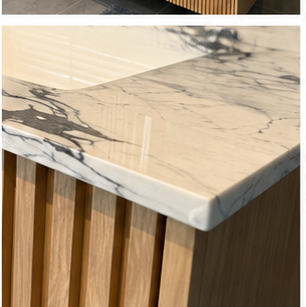
Mitred edges are used to create a sharper, more substantial-looking corner from porcelain or stone-effect material. They can work beautifully around a vanity, shelf, niche or wall return, but the visible simplicity comes from careful fabrication.
The corner is not just a 45-degree cut
The actual cut depends on the material thickness, edge profile, corner geometry and the support beneath it. The pieces must meet cleanly without creating a fragile feather edge or an exposed section that is difficult to protect.
The final wall and cabinet dimensions should be confirmed before fabrication rather than estimated from an unfinished room.
Pattern direction matters
With marble-look porcelain, the printed movement needs to be considered at the corner. A technically neat mitre can still look wrong if the vein stops abruptly or the two faces are not arranged intentionally.
This is especially important on a vanity or feature wall that is viewed straight on.
Protect the finished edge
Porcelain is hard and durable, but a thin exposed corner can still be vulnerable during transport, installation and later use. The design should consider where the edge is likely to be touched, struck or cleaned, and whether a different detail would be more robust in that location.
Precision is part of luxury
A mitred detail is worth using when it improves the architecture of the room. It should be supported, fabricated and installed as part of the complete vanity or wall system.
The premium result is the corner that looks effortless because the decisions behind it were not.
Continue with porcelain vanity cut-out planning, or read about stone vanity fabrication and basin support.