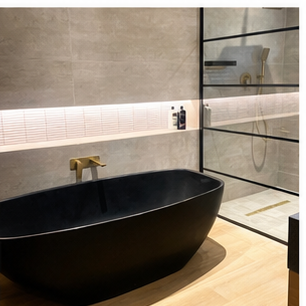
The visual appeal of a deep freestanding bath can hide a practical question: can the home provide enough hot water for the intended bath without leaving the rest of the household waiting? Bath capacity, user displacement, incoming cold water and hot-water recovery all affect the experience.
Capacity is product-specific
A long bath is not necessarily a deep bath, and a maximum capacity is not necessarily the amount a person uses. The selected manufacturer’s data should be used rather than a general rule based on outside dimensions.
The geyser is part of the specification
Check the available hot-water storage, the mixing arrangement, the temperature setting, the recovery time and other household demands. A bath that consumes a large proportion of stored hot water can affect showers, basins and kitchen use afterwards.
Flow rate controls filling time
Even when enough water is available, a low-flow filler can make a large bath frustratingly slow to fill. The selected filler’s flow rate, the actual pressure and the pipework route should be considered together.
Heat pumps and solar systems change recovery
Alternative hot-water systems may have different recovery behaviour from a conventional geyser. That does not make them unsuitable, but the bath should be assessed against the system’s real operating conditions.
Luxury should include the wait time
A deep bath is a long-term household decision, not only a visual centrepiece. Confirm the hot-water plan before the plumbing is closed and record the relevant product and system information in the handover.
Read about freestanding-bath hot-water and floor planning, or see how a freestanding bath affects floor support.