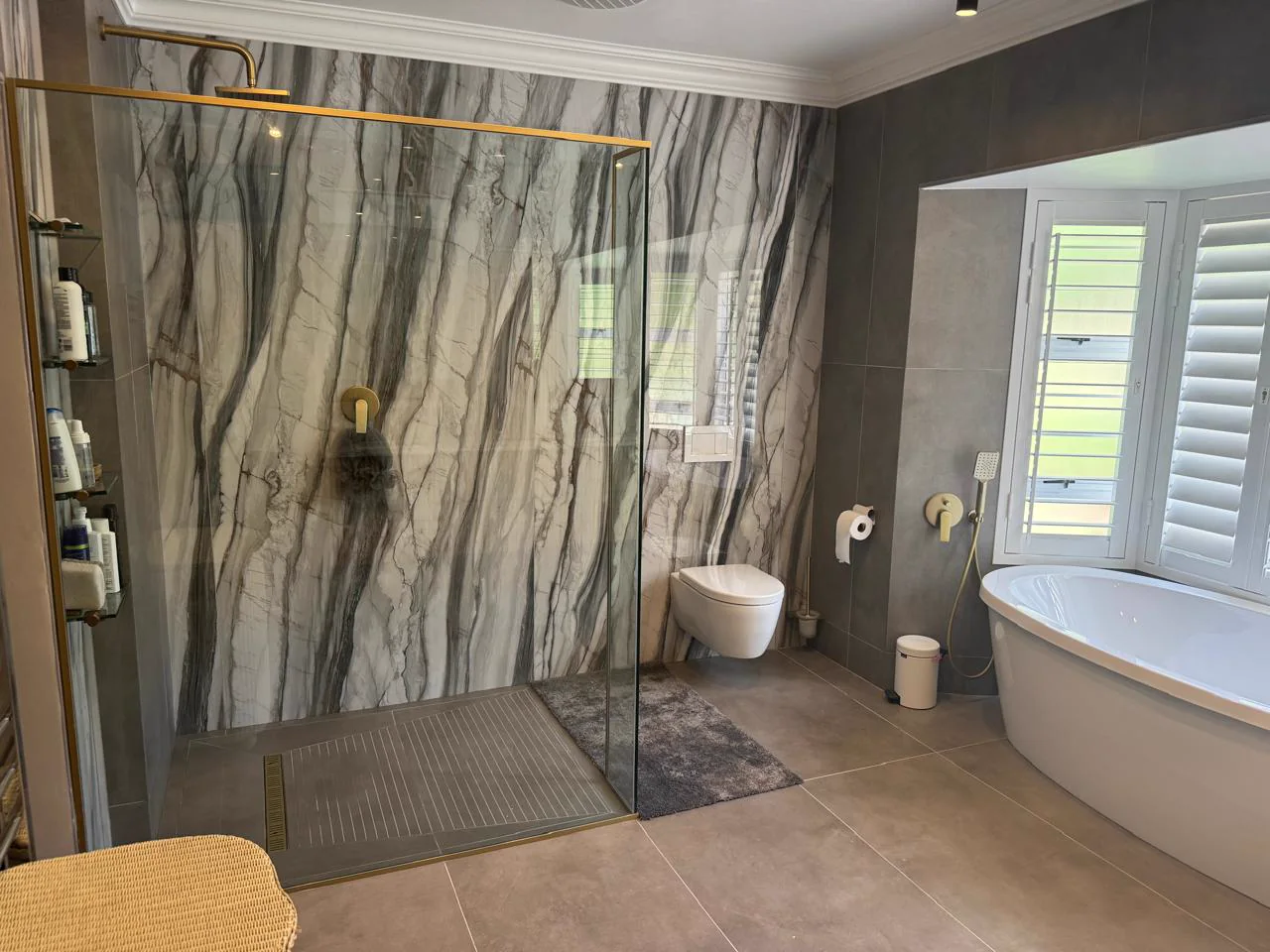
The adhesive can affect the finished colour
White marble is prized for its light background and fine movement. That light background can also reveal what sits behind it. An adhesive that is suitable for an ordinary ceramic tile may not be the right system for a pale natural stone installation.
The issue is not only whether the tile sticks. The installation must also avoid visible shadowing, staining or unwanted colour changes as the material cures and is exposed to moisture.
The exact stone has to be understood
“White marble” describes a broad family of materials rather than one standard product. Thickness, absorption, translucency, reinforcement, resin and surface finish can vary.
Some slabs have mesh or resin on the rear. Some stones are more moisture-sensitive than others. The installer should assess the actual material and follow the adhesive manufacturer’s system recommendation for the substrate and application.
White adhesive is not the whole answer
Using a white product can be important for a pale stone, but colour alone does not solve an incompatible system. Coverage, bed thickness, open time, substrate flatness, back-buttering where specified and curing conditions all influence the result.
The wall must also be prepared properly. An adhesive cannot correct movement, damp, contamination or a surface that is too uneven for the slab or tile.
Test the material before committing to the room
Where the stone is valuable or visibly translucent, a small mock-up can reveal how the adhesive, backing and stone interact before the full wall is installed. It is much cheaper to discover a compatibility problem on a test piece than after a complete shower has been finished.
In a luxury Durban bathroom, the correct adhesive is part of the stone specification, not an afterthought left to the last delivery.
See the wider Signature Bathrooms renovation approach at Durban bathroom renovations.
Related renovation guidance
For the wider project context, continue with related bathroom renovation guidance.