The broad face is rarely the first failure point
A vanity can look perfect across its doors while moisture is already entering somewhere less obvious. The centre of a factory-faced panel may remain intact while a cut edge or damaged corner begins to expand.
Typical risk points include the basin opening, the hole around the waste and supply pipes, the rear edge against a damp wall, the bottom edge near mop water and any place where the edging has lifted.
Cut-outs expose the substrate
Fabrication creates openings for basins, taps, wastes, traps, pipes and sometimes electrical services. Those openings must be cut accurately and protected according to the material and countertop system.
A decorative surface cannot be assumed to continue around a cut-out. The exposed substrate needs its own edge treatment, and the joint around the installed basin or fitting must be compatible with the product and expected water exposure.
The bottom edge matters too
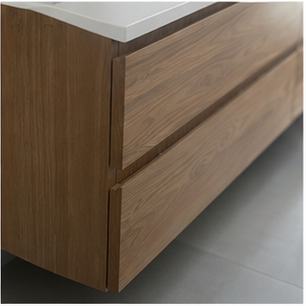
Floor-standing units face a different risk from floating vanities. The kick zone can be exposed to mopping water, shower escape and small unnoticed leaks. A floating vanity reduces floor contact but transfers more responsibility to the wall fixing and support system.
Neither design is automatically better. The correct choice depends on the wall, floor, plumbing, cleaning routine and the way the room contains water.
Prevention is easier than replacement
Ask the installer to identify the exposed edges, confirm how they are finished and show where the basin and pipe penetrations will be sealed. Also confirm how a future leak will be found without dismantling the entire cabinet.
Good joinery is not only about the front profile. It is about controlling water at the edges that nobody notices until the material has already changed shape.
Read why moisture-resistant board is not waterproof, or see how service access should be preserved in a luxury bathroom.