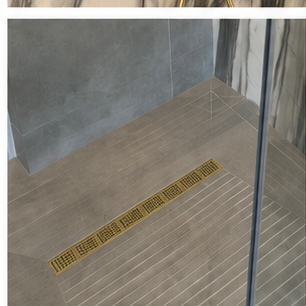
Matching the shower floor to the main bathroom floor can make a room feel continuous, but it is not the only way to create a coherent design. The shower has different drainage, wet-use and cleaning demands.
Continuity can come from tone
A related colour, stone reference or grout family may connect the zones without forcing one identical finish across the entire room. This gives the shower floor room to use a more suitable format or surface.
The result can feel more deliberate than a perfect visual match that performs poorly in the wet area.
The drain influences the format
Point drains, linear drains, falls and thresholds all affect how the shower floor is tiled. A smaller mosaic may follow a shaped fall more easily, while a larger piece may suit a directional fall toward a linear drain.
The geometry should be understood before the final tile decision.
Contrast can be useful
A slight change in tone can define the shower without making it feel separate. It can also help show the transition between the main floor and the wet zone, particularly in an open walk-in shower.
Design is not only about hiding every boundary.
Select by use, then coordinate by appearance
Choose the floor product for its actual application, finish, maintenance and drainage context. Then coordinate it with the main floor through colour, scale, grout or pattern.
A luxury bathroom feels resolved when the practical differences between zones have been turned into design decisions.
Read why small mosaic can be the premium shower-floor choice, or see why shower-floor tile size is a drainage decision.