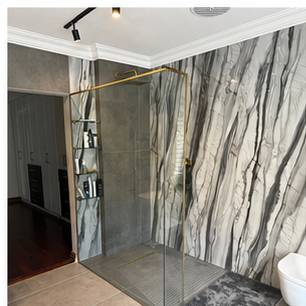
A bookmatched wall places two pieces so their visual movement appears to mirror across a centre line. The effect can be created with natural marble or with large-format porcelain, but the two materials do not behave identically.
Porcelain offers controlled repetition
Digital porcelain can provide a deliberate mirrored image across known faces and formats. It may offer a more predictable thickness, finish and maintenance routine, depending on the actual product.
The layout still needs to account for niches, mixers, windows, corners and the position of the centre line.
Natural marble brings geological variation
Real marble has variation that cannot be reduced to a printed repeat. Veins, fissures, translucency, absorption and surface response are part of the material’s identity. A natural-stone bookmatch should be selected from the actual slabs where possible rather than a small sample alone.
Both need fabrication discipline
Bookmatching magnifies small layout errors. The slabs need to be numbered, oriented, cut and installed in the approved sequence. The wall must be ready and the support, adhesive and sealing decisions must suit the chosen material.
The choice is about experience
Porcelain may suit a homeowner who wants controlled patterning and easier routine care. Marble may suit someone who values natural variation and accepts the maintenance responsibility. Neither is automatically more luxurious.
Read bookmatched marble planning, or see why tile-face variation matters.