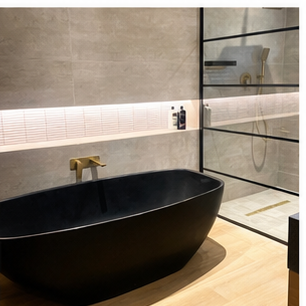
The gap around a freestanding bath is not empty space. It is where water, dust, hair and cleaning products can collect, and it is the route through which the owner needs to clean the floor and the outside of the bath.
A narrow gap is not automatically elegant
Placing the bath close to a wall can make a room feel efficient, but if the gap cannot be reached it may become a permanent dirt and moisture line. Consider the cleaning tool, the user’s hand and the floor finish before choosing the final position.
A large gap changes circulation
Moving the bath further into the room may improve access but reduce the clear route around the vanity or toilet. The bath should be set out with the full room, not treated as a separate object.
A back-to-wall alternative may be better
Where cleaning access is limited, a back-to-wall or carefully integrated bath can give a similar visual presence while simplifying the perimeter. It is not a lesser option if it suits the building and the household better.
Think about splash and ventilation
Water around the bath should be able to dry. In humid Durban and coastal KZN bathrooms, poor access combined with trapped moisture can make mould and finish deterioration more likely.
The correct gap is the one that balances appearance, movement, cleaning, service and the actual room dimensions.
Read about choosing a freestanding bath for a Durban home, or see how functional bathroom zoning works.