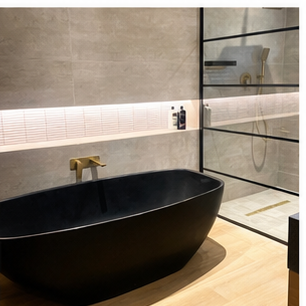
A fully freestanding bath is not automatically the best bath for every room. A back-to-wall model can offer a similar sculptural presence while improving cleaning access, reducing the gap behind the bath and simplifying the route for some plumbing arrangements.
What changes
The wall-side edge can reduce the amount of exposed perimeter that must be cleaned. It may also make better use of a narrow room, although the wall and sealing detail must be built correctly.
The bath still needs accurate set-out
The finished wall must be straight, waterproofed where relevant and suitable for the product. The waste, overflow, filler and access details remain product-specific.
Consider the visual trade-off
A back-to-wall bath can feel less like a floating object in the room. That may be exactly what the architecture needs, especially where a broad open circulation zone would make a fully freestanding bath impractical.
Cleaning and service are design benefits
Reducing an inaccessible gap can make the room easier to maintain. It does not eliminate the need for service access or a correct seal; it changes where those details are resolved.
Choose the right form for the room
The better luxury decision is the bath that gives the household comfort, proportion, reliable plumbing and a manageable cleaning routine. A back-to-wall model can achieve that more honestly than forcing a freestanding product into a constrained space.
Read about cleaning clearance around a freestanding bath, or see how a compact bath can work in a smaller room.