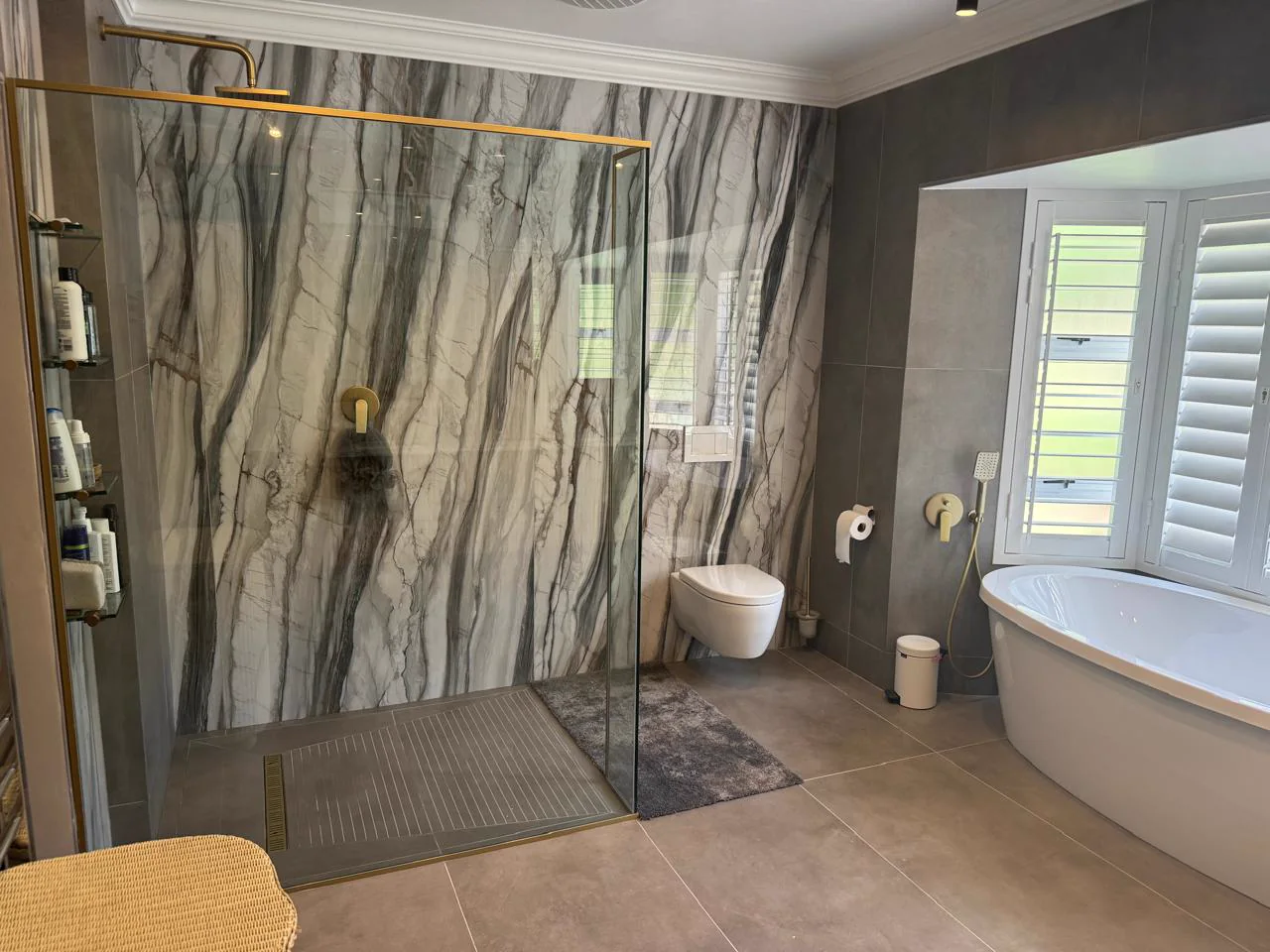
Book-matching starts at the slab yard
Book-matched marble is created by opening adjacent slabs like the pages of a book so the veining reflects across the joint. It can make a shower wall, bath surround or vanity the centre of the room.
The effect cannot be reliably planned from a small sample. The actual slabs, their vein direction, usable dimensions and natural marks need to be reviewed before fabrication.
The room determines the cut map
The fabricator needs the final wall dimensions, niches, mixer outlets, glass positions, vanity cut-outs and service penetrations. The cut map should show where the strongest movement will land and which sections may be hidden or removed.
A dramatic vein disappearing into a basin cut-out may be unavoidable, but it should be a deliberate decision. On an expensive slab, planning the cuts is part of the design work.
Book-matching has technical limits
Natural slabs are not printed sheets. Thickness, fissures, resin repairs, mesh backing, colour variation and available bundle quantity can limit how closely the pattern can be matched.
The stone also needs the correct support, adhesive and wet-area preparation. A perfect visual layout cannot compensate for an unsuitable substrate or a waterproofing system that was punctured during installation.
Use the strongest pattern where it will be seen
The main sightline may be behind a freestanding bath, opposite the bathroom entrance or across a shower wall. The design should consider the mirror, lighting, fittings and glass before deciding which slab face is the hero.
Book-matched marble is at its best when the visual ambition and the installation method are planned together.
Read about Signature Bathrooms at our renovation process.
Related renovation guidance
For the wider project context, continue with related bathroom renovation guidance.