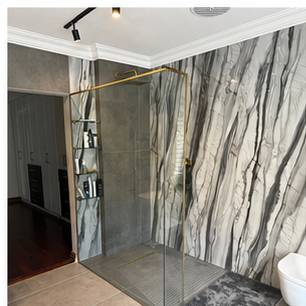
Tile selection is one of the most consequential decisions in a bathroom renovation. The tiles will be on the walls and floor for ten to twenty years. They determine the room’s appearance, how easy it is to clean, how well it performs in a coastal climate, and — in ways many homeowners do not anticipate — how the renovation programme is sequenced and priced.
Making the selection before stripping begins prevents mid-project delays and avoids the mismatch between imagined and actual result that causes the most renovation regret.
Tile body types: what you are actually buying
Fully vitrified porcelain. The highest-density tile body. Water absorption below 0.5%. Resistant to moisture, frost, salt and staining. The correct choice for wet areas in KZN, particularly in coastal locations. Harder to cut than ceramic, which requires a wet-cut diamond blade, but the durability over a coastal lifetime justifies the additional installation effort.
Ceramic. A lower-density body with higher water absorption — typically 3 to 7%. Suitable for dry wall areas and lower-use bathrooms in non-coastal settings. Cheaper to buy and easier to cut. Not the recommended choice for shower walls and floors, particularly in Ballito, Umhlanga, La Lucia and the North Coast, where humidity and salt air accelerate any moisture ingress.
Natural stone. Marble, travertine and slate have genuine tactile and visual qualities that no porcelain can fully replicate. They require sealing on installation and periodic re-sealing thereafter. In a coastal bathroom, unsealed or inadequately sealed natural stone absorbs moisture and deteriorates faster than in a drier climate. If natural stone is specified, the sealing programme must be included in the maintenance plan.
Engineered stone and large-format slabs. A growing category. Large-format porcelain slabs (600×1200mm, 800×1600mm and larger) give a stone-like appearance with none of the porosity. Set-out precision is critical at these sizes — a tiler who cannot set out a large-format floor correctly will produce a result that looks worse than a smaller tile. Confirm your tiler’s experience with the format before ordering.
Tile size and what it means for the room
Large format (600×600mm and above). Fewer grout joints, easier to clean, reads as more contemporary. Works best in rooms with regular geometry — square or rectangular with no complex setouts. Requires a flat substrate and an experienced tiler. A large-format tile on an uneven floor will hollow-bond (contact the adhesive only at the edges) and break underfoot within months.
Medium format (300×600mm, 300×300mm). The most forgiving size for irregular rooms, older properties with unlevel floors, and tilers working within a constrained programme. Still reads as clean and contemporary when set out well.
Mosaic and small format. High grout-joint density increases cleaning effort and provides more pathways for moisture ingress. Used well as a feature or niche liner, a mosaic adds texture and interest. Used on an entire floor or shower wall, it is a maintenance commitment. In a rental or high-use bathroom, small-format tiles on the floor are difficult to keep looking clean between visits.
Finish selection
Matte and satin. The dominant choice in contemporary bathroom renovations. Hides water marks, footprints and soap film better than polished. Provides a degree of slip resistance on the floor. Works well in KZN’s natural light.
Polished and semi-polished. Shows water marks within hours of cleaning. Requires more frequent maintenance to look clean. Works well in low-traffic, low-humidity bathrooms — a guest bathroom that is rarely used, for example — but is a demanding choice in a daily-use shower.
Textured and grip-finish floor tiles. Required by SANS 10400 for commercial wet areas. In a residential bathroom, a textured floor tile provides meaningful slip resistance, particularly for older occupants or households with children. The texture must be sufficient to grip without being so aggressive that it traps soap and is difficult to clean.
Rectified tiles. Rectified tiles are precision-cut to exact dimensions after firing, allowing very narrow grout joints (as little as 1.5mm). Standard (calibrated) tiles have slight size variation that requires a wider joint to compensate. For a large-format contemporary installation, rectified tiles and a narrow joint produce a cleaner result — but the installation requires a higher standard of adhesive bed preparation.
Grout: the part of the selection most people get wrong
The grout joint is what gets dirty. Not the tile surface — the grout.
Cement grout is the standard and the cheapest. It is porous, absorbs soap and minerals from the water, and stains over time regardless of how well it is cleaned. In a KZN coastal bathroom with hard water, cement grout in a shower requires active maintenance to prevent discolouration within two to three years.
Epoxy grout is non-porous, chemically resistant, and will not stain or harbour mould. It costs more to supply and takes longer to install — epoxy requires a specific cleaning process to remove haze during installation. The result lasts the lifetime of the tile installation without the discolouration cycle that cement grout goes through.
For shower walls and floors in any bathroom that will be used daily, epoxy grout is the correct specification. For dry wall areas — the painted wall behind a vanity, for example — cement grout is adequate.
Coordinating tiles with the rest of the room
Select the tile before selecting the brassware, vanity and sanitaryware. The tile establishes the dominant tone, texture and scale of the room. Everything else coordinates to it — not the other way around.
A warm-toned travertine-effect porcelain wants warm brass or matte black hardware. A cool grey large-format porcelain works with brushed nickel or chrome. A white-on-white setup with a subtle texture reads well with any hardware but needs the lighting to be considered carefully to avoid the room reading as flat.
Bring tile samples into the actual bathroom under the actual light before ordering. KZN’s natural light is warm and direct, and tiles that look grey in a showroom can read quite differently in a north-facing bathroom at noon.
View tile selections in our completed projects in the portfolio, or contact Signature Bathrooms to discuss your selection for a renovation in Durban, Umhlanga, Ballito or the Upper Highway. For the technical side of tile selection, see our guide to reading a tile technical data sheet.