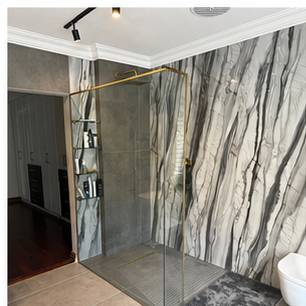
Large-format porcelain can make a bathroom appear almost continuous, but the building beneath it still expands, contracts and moves. Fewer visible joints do not mean the installation no longer needs movement detailing.
Movement has to go somewhere
Changes in temperature, moisture, substrate behaviour and the relationship between different materials can place stress on a tiled surface. Perimeter joints, changes of plane and other movement details give the system somewhere to accommodate that stress.
The exact arrangement depends on the substrate, room, tile system and manufacturer’s installation guidance.
A rigid grout joint is not a movement sealant
Grout fills the designed joint between tiles. It is not a substitute for a flexible sealant at a movement joint or change of plane. Filling every junction with hard grout can make the finished surface look neat at handover while leaving the system less able to respond to movement.
Corners, wall-to-floor junctions, edges and transitions should be considered during the layout rather than repaired after cracking appears.
Large tile makes planning more visible
When a large tile spans a wall, a crack or tented section can affect a substantial area. The layout must therefore work with the building’s existing joints, openings and changes in material. A beautiful surface cannot be separated from the construction underneath it.
Quality is in the details no one notices
The best movement joint is often the one that disappears into the design. It is coordinated with tile lines, fittings, corners and sealant colour so that it performs its purpose without becoming a visual distraction.
In a luxury Durban bathroom, quiet surfaces depend on controlled movement, not on pretending that movement does not exist.
Read why rectified tiles still need grout, or see what sits beneath a properly waterproofed shower.