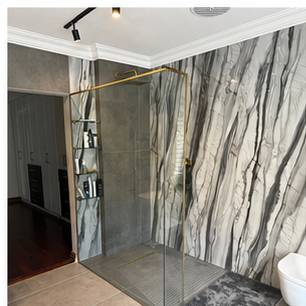
Natural stone gives a shower enclosure depth and variation that manufactured surfaces may not reproduce. It also demands care when glass hardware is fixed through or beside it. The stone, waterproofing, substrate, glass and hardware should be treated as one interface.
Drilling is a planned operation
Stone can chip, crack or stain if a hole is placed too close to an edge or cut with unsuitable equipment. The glass layout and hardware positions should be confirmed before the stone is fabricated or installed.
The stone is not automatically the backing
A beautiful slab or tile face may conceal a substrate that is not suitable for a hinge, clamp or stabiliser. The fixing must reach the correct structural support while protecting the waterproofing behind the finish.
Sealant and stone compatibility
Natural stone may be sensitive to staining or to chemicals in sealants and cleaners. The selected products should be checked for compatibility with the specific stone and its sealer. A generic silicone choice can leave a permanent mark.
Water marks show quickly
Dark and polished stones can reveal mineral deposits around the base of the glass. The enclosure should be designed so the perimeter can be wiped and the stone does not trap water behind clamps or channels.
Coordinate the visual line
The glass edge should relate to stone joints, veins, niches and the drain. A few millimetres of planning can prevent a hinge landing on a dramatic vein or a clamp interrupting a carefully book-matched surface.
Read about shower-glass waterproofing penetrations, or see how natural stone needs sealing and maintenance.