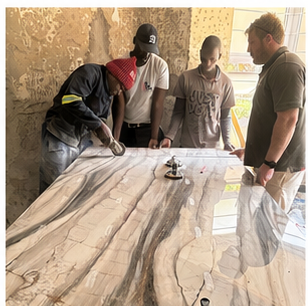
Large porcelain slabs are strong when they are properly supported, but a sharp internal cut can create a vulnerable point. Niches, sockets, mixer openings and other penetrations need more than a line drawn on a wall.
Corners concentrate stress
A tight internal corner can focus handling and service stress into one small area. The risk depends on the material, thickness, cut size, support, edge treatment and installation system, so the exact fabrication guidance for the product should be followed.
The general principle is simple: avoid creating a fragile corner when the design can achieve the same result with better geometry.
Layout can reduce the problem
A niche or outlet may be positioned so that it falls within a more stable part of the piece or aligns with a joint. Sometimes a small change in the tile layout produces a stronger and cleaner result than forcing a cut into the centre of a slab.
This is another reason to coordinate plumbing, electrical work and tile elevations before fabrication.
The cut is only half the detail
The slab also needs proper support during transport, cutting and installation. A beautifully fabricated opening can still be damaged if the piece is carried incorrectly or fixed to an unsuitable substrate.
Luxury details need engineering discipline
Large-format porcelain rewards clean design, but the cleanest-looking detail is not always the easiest one to fabricate safely. A controlled radius, joint or trim detail may protect the material without compromising the room’s appearance.
Read why mitred porcelain edges need specialist planning, or see waterproofing around shower niches.