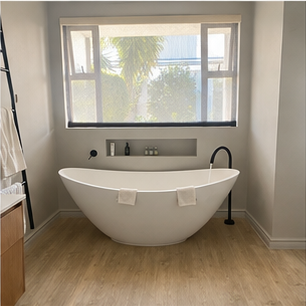
An older Durban bathroom can look straightforward until the first tile comes off.
Behind the visible room may be an earlier floor level, a former washhouse arrangement, a concealed leak, an abandoned waste, several layers of tile or pipework that was added when the house was altered. The room’s history is often visible only once the renovation begins.
That is why Richard McKie’s experience through Reno Incorporated and Signature Bathrooms begins with investigation rather than a catalogue.
The room may have changed several times
Historical descriptions of Natal homes show that bathrooms, washhouses, lavatories and household service areas did not always occupy the same role. As water supply, drainage and domestic expectations changed, buildings were adapted.
An older bathroom may therefore be:
- an original bathroom with later fittings;
- a washhouse converted into a bathroom;
- a bedroom or cupboard area adapted for plumbing;
- a bathroom enlarged into an adjoining space;
- a room tiled over more than once;
- a wet area created without a complete modern waterproofing system.
The correct renovation approach depends on which of these conditions exists.
What should be checked before demolition
Before removing the room, a renovation team should document the existing condition. Useful checks include:
- the location and material of hot and cold water pipes;
- the route, size and fall of waste connections;
- the floor construction and finished floor levels;
- damp, staining and signs of previous leaks;
- the condition of the existing screed and substrate;
- the shower’s waterproofing history, if it can be established;
- the position of electrical cables and equipment;
- ventilation routes and whether extraction reaches the outside;
- walls that may require structural backing for a vanity, basin or toilet frame.
This is not wasted time. It is what allows the new design to be priced and sequenced honestly.
Why a tile layer does not tell the whole story
Tiles are the visible finish, but they are not the complete waterproofing system. A bathroom can have attractive tiles over a substrate that is cracked, damp or poorly prepared.
Older renovations may also contain incompatible materials: a rigid surface over a moving substrate, adhesive applied over contamination, a waste connection that allows water to remain under the screed, or sealant that has been used to conceal a junction that should have been rebuilt.
When the existing failure is beneath the visible layer, tiling over it preserves the problem. The correct decision may be local repair, partial removal or complete stripping back. That decision should follow inspection rather than a blanket rule.
Durban’s older building stock adds practical questions
Durban homes vary widely in age, construction and exposure. A coastal apartment, a timber-framed older house, a solid masonry home and a later suburban property do not present the same renovation conditions.
In Umhlanga, Umdloti and the North Coast, coastal humidity and salt exposure may also affect hardware and ventilation planning. In an apartment, body corporate permissions, working hours, waterproofing responsibilities and service routes can be as important as the interior design.
The location is part of the technical brief.
Investigation protects the luxury finish
Luxury materials deserve a stable base. Large-format porcelain, natural stone, a frameless glass enclosure, a wall-hung vanity or a concealed mixer all depend on accurate preparation.
Before ordering, the team needs to know:
- the final wall thickness;
- the finished floor height;
- the required fall to the waste;
- the location of the concealed mixer body;
- the glass fixing zones;
- the support available behind wall-hung items;
- the access route for large stone, glass and sanitaryware.
If these details are resolved late, the expensive finish becomes the part forced to hide earlier uncertainty.
Thirty-five years of practical context
Richard has been involved in renovation and construction through Reno Incorporated for roughly 35 years. That long practical perspective matters because older bathrooms often carry evidence of decisions made by several previous owners and contractors.
The job is not to erase that history blindly. It is to identify what can remain, what must be replaced, and what needs to be documented before the room is closed again.
The best result is a bathroom that feels calm and complete because the difficult decisions were handled before the final surfaces went in.
For a step-by-step starting point, see our bathroom renovation planning guide, our article on stripping an old bathroom back to the substrate, and our guide to what sits beneath a properly waterproofed shower.
Research note
This article uses the Natalia archive as historical context for changing domestic bathrooms, washhouses, lavatories and water services in Natal. The archive does not replace a site inspection, and no historical example should be assumed to describe every Durban property. Renovation recommendations must be confirmed against the actual building and applicable professional requirements.