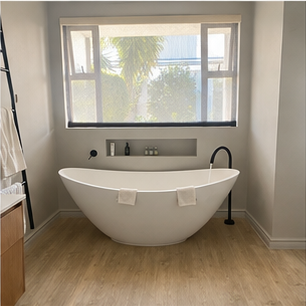
When Richard McKie began working through Reno Incorporated roughly 35 years ago, the bathroom renovation industry was already changing. Older homes still contained bathrooms that had been altered in stages: a shower added where a bath once stood, a separate toilet brought into the main bathroom, or plumbing extended into a room that was never originally designed as a wet area.
That experience now sits behind Signature Bathrooms. A bathroom is not only a collection of new fittings and finishes. It is also the latest version of a room that has changed dramatically over the history of Durban and Natal homes.
The bathroom was not always an indoor room
The historical record does not describe one single route from an outdoor lavatory to the modern bathroom. Different homes, buildings and communities adopted water, drainage and private washing facilities at different times.
In older Natal houses, washing and sanitation could be divided between several spaces. A washhouse might serve practical household needs, while a lavatory remained outside the main house. Some properties relied on earth closets, privies or other arrangements that required different maintenance from a modern water-borne system.
This is important when renovating an older Durban property. A room may look like a bathroom today while still carrying the limitations of an earlier building: shallow service routes, an unsuitable floor structure, old waste connections, or a wall that was never intended to contain modern plumbing.
The visible tiles are only the last layer of that history.
Early bathrooms were signs of changing domestic expectations
Natal historical material records homes in which a bathroom appears alongside bedrooms, reception rooms, kitchens, pantries and washhouses. The arrangement tells us something about domestic expectations at the time.
The bathroom was becoming a defined part of the house, but it was not necessarily the open, easily serviced room that we expect today. Privacy, water supply, drainage, ventilation and the work required to maintain the room all influenced where it could be placed.
An early bathroom could therefore be a sign of comfort and status, but it could also be technically constrained. A renovation that ignores those constraints may produce an attractive room while leaving the original weaknesses underneath it.
Running water changed the meaning of comfort
The arrival and expansion of reliable water services changed more than the type of tap installed in a home. It changed the daily rhythm of washing, the position of sanitary fittings, the expectations placed on domestic staff and homeowners, and the design of new housing.
Later housing descriptions in Natal refer to homes with bathrooms, baths and hot and cold water. That combination is easy to take for granted now. It required coordinated supply, waste removal, heating and maintenance, all within a building that had to keep moisture away from the rest of the structure.
Modern renovation work still depends on the same relationships. A rain shower must be matched to available flow and pressure. A concealed mixer must be coordinated with the finished wall depth. A freestanding bath needs a properly planned waste and sufficient support. Waterproofing must be completed before the room is covered with tile.
The technology has changed. The need to coordinate the systems has not.
Sanitary fittings became part of architectural design
Historical references to imported bathroom and sanitary fittings show that these products were already part of the architectural language of better-appointed buildings. Fittings were not merely hidden plumbing components. Their appearance, material and finish contributed to the character of a room.
That remains true in a luxury bathroom today, but premium products make coordination more important rather than less. A high-end tap, concealed shower system or wall-hung toilet still has to work with the pressure, pipework, substrate, waterproofing and access conditions of the particular property.
Richard’s experience through Reno Incorporated and now Signature Bathrooms is valuable here because product selection is only one part of the decision. The installation environment must be understood before the product is ordered.
Tiles and surfaces also carry a local history
The historical archive contains references to decorative tiles, marble and other architectural surfaces in Natal buildings. These materials helped communicate permanence, status and care, particularly in verandas, public buildings, hotels and substantial houses.
Contemporary bathroom design has access to a much wider range of porcelain, natural stone, sintered surfaces, engineered stone, glass and specialist finishes. But the underlying question is familiar: where will the material be used, how will water reach it, how will it be cleaned, and how will it age in the local climate?
A beautiful surface is not automatically a suitable wet-area surface. Tile absorption, slip resistance, adhesive compatibility, movement joints, stone sealing and maintenance all matter. In coastal areas such as Umhlanga, Umdloti and the North Coast, the surrounding humidity and salt exposure also influence hardware and surface maintenance.
What this means when renovating an older Durban bathroom
When renovating an older bathroom, the first question should not always be “Which tiles do you like?” It should be “What is this room made of, and how did it become a bathroom?”
Before demolition or ordering products, it is worth establishing:
- where the existing hot, cold and waste pipes run;
- whether the floor is a slab, screed, timber structure or another build-up;
- whether the existing shower has a sound waterproofing system;
- whether the waste route can support the proposed layout;
- whether the walls can support a wall-hung vanity, basin or toilet frame;
- how ventilation and replacement air will be handled;
- whether the building has body corporate or heritage restrictions;
- which concealed components will remain accessible for maintenance.
The history of the room is practical information. It helps explain why an apparently simple renovation may involve more preparation than the finished photographs suggest.
Thirty-five years of changing bathrooms
Richard’s work began with Reno Incorporated roughly 35 years ago, long before the current language of luxury bathroom design, concealed systems and large-format porcelain became common in the market. That experience provides a useful bridge between the old and the new.
The lesson is not that older bathrooms were poorly designed or that modern bathrooms are automatically better. It is that every bathroom belongs to a building, a period and a way of using water. Good renovation work respects that context while improving the room for the people who use it now.
At Signature Bathrooms, the finished room is only the visible result. The quality of the work is also in the investigation, sequencing, preparation and coordination beneath it.
For a practical guide to planning a renovation, see our bathroom renovation planning guide. For Durban renovation work, visit our Durban bathroom renovations page.
Research note
This article was informed by historical material in the Natalia archive of the Natal Society Foundation, including discussions of domestic buildings, bathrooms, washhouses, sanitary fittings and water services in Natal. The archive is a starting point rather than a complete architectural history of every Durban home. Historical examples from Natal are identified as historical evidence and are not presented as universal building practice.
Richard McKie’s practical perspective reflects his work through Reno Incorporated and Signature Bathrooms. It does not replace a property-specific inspection, structural assessment or professional plumbing and electrical advice where those are required.