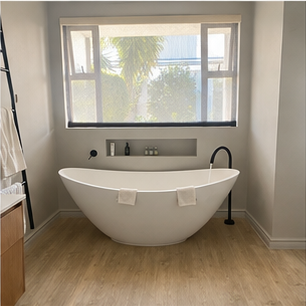
The idea that bathroom fittings can be architectural features is not new. Historical material from Natal refers to imported sanitary fittings, bathroom and toilet fittings, cast-iron verandah work and other manufactured elements that helped define substantial buildings.
What has changed is the range of products available. What has not changed is the need to choose fittings as part of the building rather than as isolated objects.
Sanitary fittings were once specialist manufactured goods
In earlier periods, a bathroom fitting was not necessarily sourced from a local shelf with dozens of visually similar alternatives. Manufactured sanitary goods were imported, specified and installed as part of a larger building project.
Their material, shape and finish affected how the room was perceived. A basin, bath, tap or toilet was part of the room’s visible architecture, just as a door handle, fireplace or tiled veranda was.
This is one reason historic buildings can still feel coherent. The visible fittings were selected to belong to the building’s style and level of finish.
The modern premium fitting creates the same responsibility
Today, a premium bathroom may include a concealed mixer, thermostatic shower, wall-mounted basin tap, freestanding bath filler, specialist flush plate or custom vanity hardware.
These products are more technically sophisticated, but they still need to belong together. The collection, finish, proportions, projection and installation depth all influence the result.
A fitting can be expensive and still look wrong if:
- its projection does not suit the basin;
- its finish conflicts with the other hardware;
- its rough-in body is incompatible with the trim;
- its working pressure does not suit the supply;
- the finished wall depth was not allowed for;
- the spare parts and service access were ignored.
Luxury is not simply the price of the fitting. It is the quality of the decision around it.
Why product families matter
Historical interiors often used repeated materials and forms to create a consistent language. The same principle applies to a contemporary bathroom.
Using one tap collection across a basin, bath and shower can create visual continuity. It can also simplify maintenance, provided the range remains supported and the products are genuinely compatible.
However, products that look similar are not automatically engineered as one system. Different manufacturers may use different rough-in bodies, cartridge dimensions, pressure requirements and service procedures.
The product schedule should record the actual manufacturer, model and concealed component, not only a colour or catalogue photograph.
Richard’s practical view
Richard McKie has been involved in renovation and construction through Reno Incorporated for roughly 35 years. That experience informs how Signature Bathrooms approaches premium fittings.
The attractive part of a fitting is obvious. The less visible questions often determine whether the installation remains satisfactory:
- Can the cartridge be replaced later?
- Is the spare-parts route clear?
- Does the finish have specific cleaning requirements?
- Is the installation manual available for the actual model?
- Will the fitting remain accessible after tiling and joinery?
- Has the plumber flushed the pipework before the cartridge is connected?
These questions belong in the design discussion, not only in the handover folder.
From imported fittings to local coastal conditions
Historical Natal buildings used products that had to arrive, be installed and be maintained far from their original manufacturers. Contemporary Durban projects face a related issue when premium imported fittings are specified.
A product can be available through a showroom but still require careful confirmation of local support, warranty terms and spare parts. Coastal conditions add another maintenance consideration. Brushed, black, brass-coloured and other finishes can be damaged by harsh chemicals, salt residue and incorrect cleaning.
The right question is not only “Does this finish look good in the showroom?” It is also “Can this household maintain it in this location?”
A fitting should be chosen with the room
The best result comes when the fitting schedule is coordinated with:
- basin and bath geometry;
- tile and stone thickness;
- vanity construction;
- mirror position and lighting;
- shower glass clearance;
- finished floor and wall levels;
- cleaning and service access.
That coordination is what makes a bathroom feel intentional rather than assembled from unrelated products.
For more on premium tap selection, see our premium shower specification workflow and our guide to recording cartridge and spare-part information.
Research note
This article was informed by historical Natal material referring to sanitary, bathroom and toilet fittings in architectural contexts. The archive shows selected historical examples and does not establish a complete catalogue of products used in Durban. Modern product requirements remain manufacturer-specific.