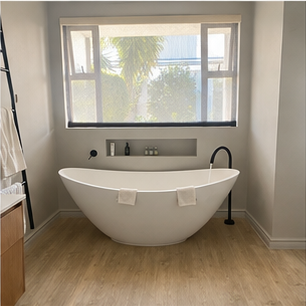
The luxury bathroom did not begin with social media images of freestanding baths. Earlier Natal hotels, substantial homes and first-class accommodation were already teaching people to associate bathing with privacy, comfort, good materials and careful service.
The historical archive contains references to bathrooms in substantial houses, dedicated bathroom accommodation and first-class cabins arranged with privacy in mind. These examples are useful because they show that luxury has always involved more than decoration.
Comfort begins with how the room is used
A hotel bathroom has to work for a guest who may not know the building. A substantial home bathroom has to work for the household every day. Both require the room to be legible.
The user should understand where to stand, where to place belongings, how to operate the fittings, where water will go and how the room will be cleaned. The modern luxury bathroom benefits from the same clarity.
This is why layout matters as much as the tile selection. A beautiful bath placed where it obstructs movement is not luxurious. A rain shower that floods the room is not luxurious. A vanity without usable storage creates visual calm at the expense of daily convenience.
Privacy was always part of the specification
Historical references to private bathroom arrangements show that privacy was a design concern long before the modern ensuite.
Today privacy must be coordinated with glazing, doors, views, bedroom sightlines and the placement of the bath or shower. A bath beside a window can be an exceptional design feature, but only if the glass, blinds, landscaping and neighbouring properties have been considered.
The view is part of the design. So is what the view reveals.
Hospitality taught us to think about sequence
Good hotel bathrooms are often memorable because the sequence feels natural:
- the door opens onto a clear view;
- the basin and mirror are easy to find;
- the lighting is useful rather than harsh;
- the shower and bath are positioned without awkward crossings;
- towels and products have somewhere deliberate to live;
- the materials are easy to understand and maintain.
These principles can be adapted to a home without turning the bathroom into a hotel set. The aim is not imitation. It is to bring the same attention to movement, light, storage and serviceability.
The expensive detail is often the quiet detail
Historic buildings often used substantial materials, but their sense of quality did not come from covering every surface with ornament. It came from proportion, workmanship, durable fittings and the relationship between materials.
In a modern bathroom, quiet quality may be found in:
- a correctly aligned stone joint;
- a shadow gap that was planned before plastering;
- a shower niche waterproofed properly;
- a mirror positioned with the basin and lighting;
- a bath filler with the correct reach;
- a door that opens without striking the vanity;
- a service access point that is present but unobtrusive.
These details may not be obvious in a first photograph. They are obvious every time the room is used.
Richard’s practical interpretation
Richard McKie has been working through Reno Incorporated for roughly 35 years and now brings that experience to Signature Bathrooms. His perspective is useful because luxury bathroom design has to survive the gap between the concept image and the building site.
The room needs a design that can actually be installed:
- the substrate must be suitable;
- the waterproofing must be continuous;
- the plumbing must be accessible and compatible;
- the glass must be measured at the right stage;
- the joinery must tolerate the environment;
- the final maintenance routine must be realistic.
Hospitality can inspire the experience. Construction discipline delivers it.
A Durban and KZN interpretation of luxury
Durban homes add local conditions to the design brief. Humidity, coastal exposure, apartment rules, water pressure, ventilation and the age of the building all influence how a luxury bathroom should be specified.
An elegant bathroom in Umhlanga may require different hardware care from one inland. A high-rise apartment may have different drainage and access limits from a freestanding house in Durban North. A heritage property may need a different approach from a new build.
Luxury is therefore not one visual style. It is a room that has been designed for its setting and its users.
For related modern guidance, see our articles on hotel bathroom ideas worth adapting at home, baths beside windows and testing serviceability in a luxury bathroom.
Research note
This article uses historical Natal references to hotels, substantial homes, cabins and domestic comfort as context. It does not claim that one historic building represents all Natal architecture. Modern recommendations remain specific to the property, products and installation conditions.